Overview
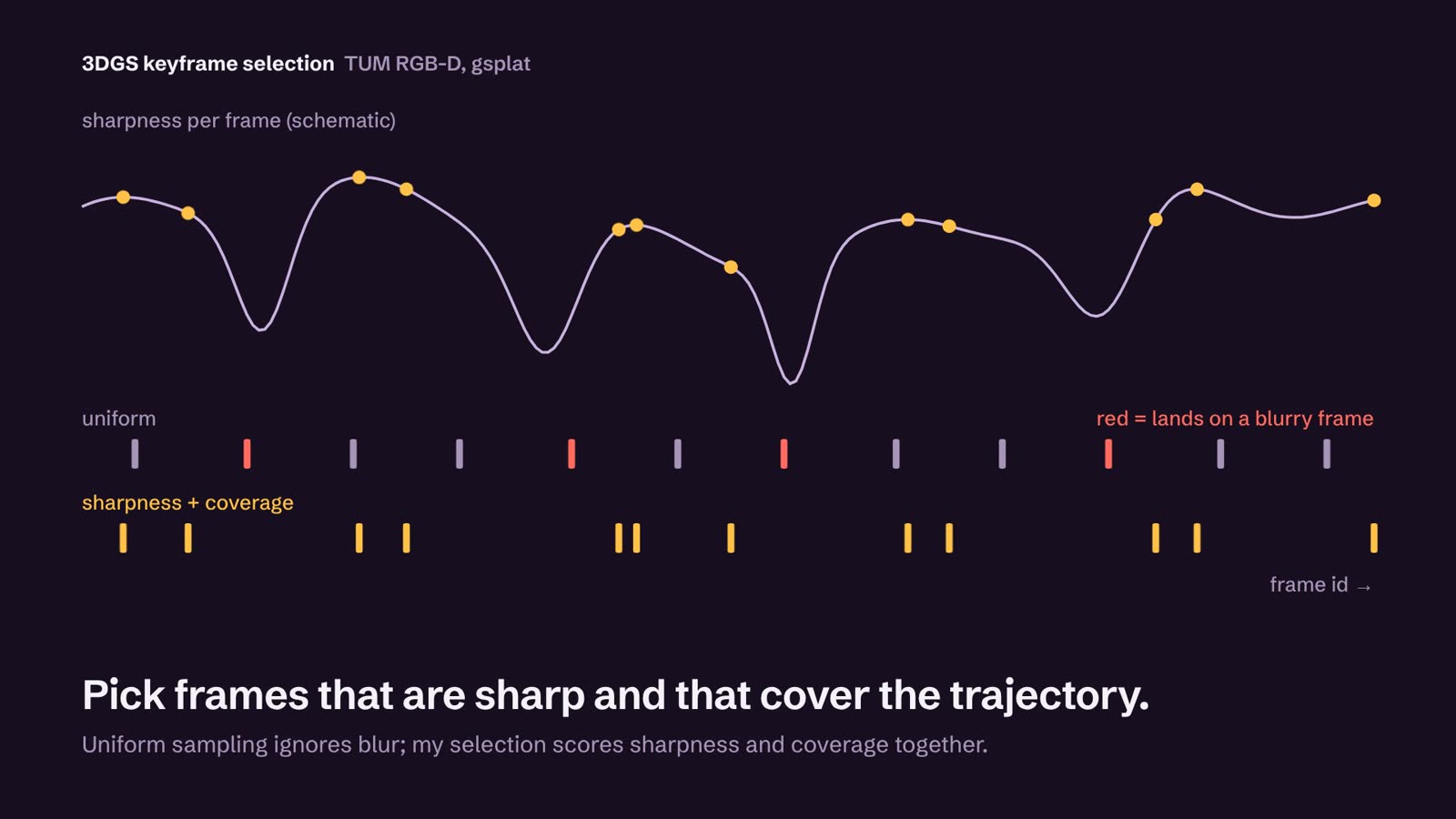
3D Gaussian Splatting trains on posed images, and a handheld RGB-D sequence contains many blurry or near-duplicate frames. I designed a keyframe selection that scores sharpness and trajectory coverage together, and compared it with uniform sampling at budgets of 30 and 60 frames.
Setup
- Renderer
- 3D Gaussian Splatting with gsplat, 7k iterations
- Data
- Three TUM RGB-D sequences: freiburg1_desk, freiburg1_room, freiburg2_xyz
- Budgets
- 30 and 60 training frames, which is 1.7–21.1% of the available frames
- Baselines
- Uniform sampling, random, blur-only selection, and all frames
- Seeds
- Two per setting
Results
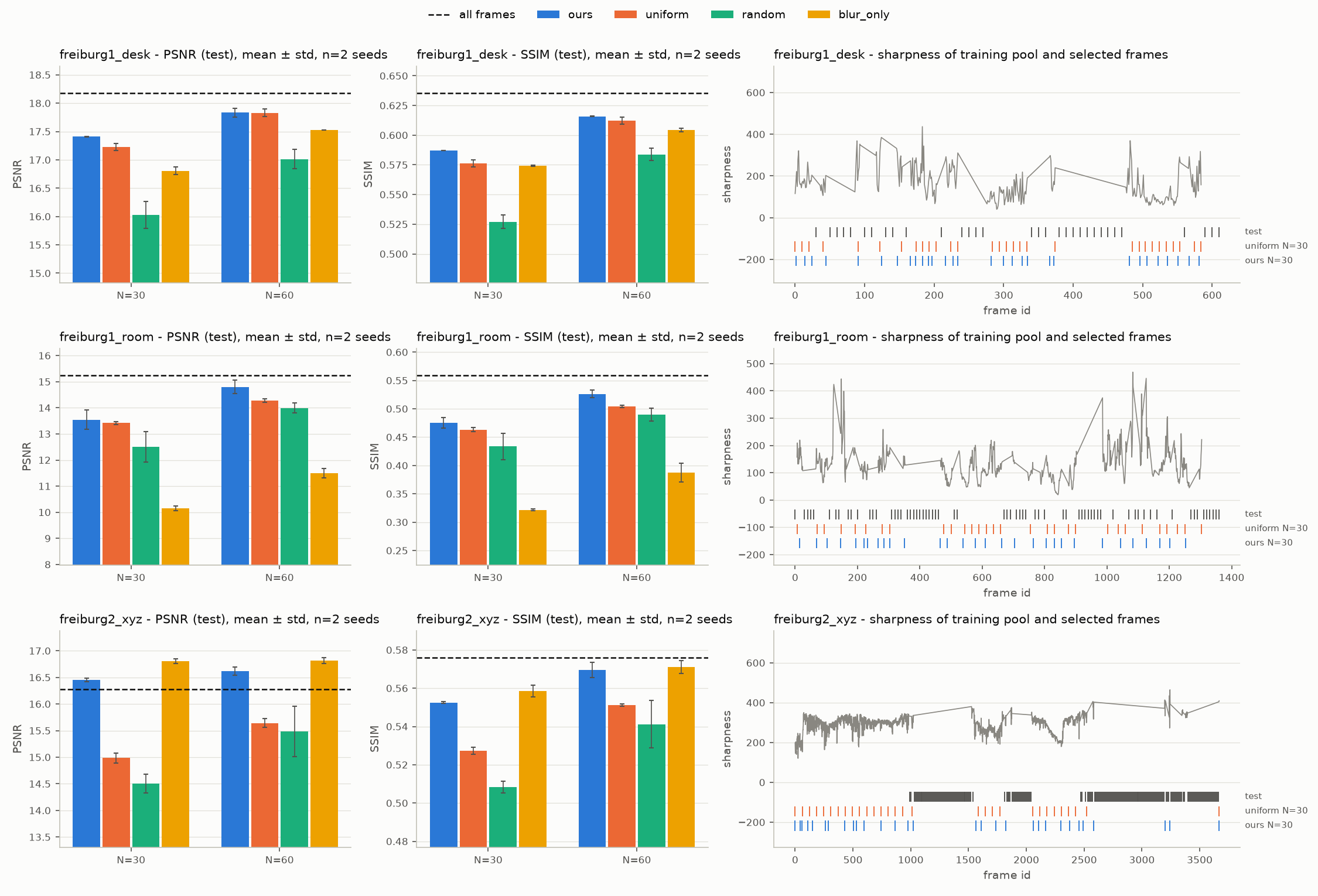
Across the six scene and budget settings, the selection averaged +0.55 dB PSNR (range 0.0–1.5) and +0.015 SSIM (0.004–0.025) over uniform sampling.
Limits
- Results varied by scene. On desk at 60 frames, the PSNR difference was within seed noise.
- Blur-only selection outperformed this method on fr2_xyz.
- LPIPS was not measured.
 View selection for data-efficient 3D reconstruction
 찰칵의 덕후: photo studio and photographer finder app
 Long-video understanding in a third of the KV memory